Thursday, 25 July 2013

Birds, birds, birds!


I realise that I’ve been absolutely awful at updating the blog recently, which I apologise for. Even though we are now in the middle of winter, I’ve been pretty busy. A fair amount of things have happened in the last month and a half. I’m going to split it up into different sections, so this isn’t just one mammoth post.
The first one is going to be about the birds on the island.

 There has been even more change with the complete departure of the Grey-headed Albatross chicks. They finished just before mid winter on the 20th June. Compared to last year they were fledging a lot later, which meant more daily trips to the colonies. It was strange going up to colony B for the last time which overlooks Big Mac penguin colony. Both were completely empty and silent; so different from the main season when the noise of the penguins can be heard over a kilometre away, and the albatross chicks are begging for food, and the adults are chattering amongst themselves. However although I was a little sad to see the place so deserted, as least the chicks that have left the island are hopefully beginning what could be a long life roaming the oceans and returning to the same colony in a few years to breed. In around three months time the adults will be back for another few busy months of chick rearing. 

Wanderer chick practicing flapping.
The only type of albatross now left on the island is the Wandering Albatrosses. The chicks are growing rapidly in size and some look almost bigger than their parents. The chicks will end up weighing more than their parents, and will lose their baby fat just before they fledge, so they can actually get off the ground! I often see the parents returning to feed the chick hearty meals of fish and squid. They get fed on average once a week, with the two parents flying potentially thousands of miles between feedings. 

Once a month everyone on base goes out and checks on all of the chicks across the island to check for failures. The last couple of months have had very few failures, this is because the chicks are now so large that the other predators (Giant Petrels/Skuas) are too small to be able to take them on (unless they are injured or sick). The main reason for failure is if one of the parents is killed by a long line fishing boat, and the other cannot usually manage to provide enough food and the chick starves. We have one chick that this has happened to named “Tiny Tim”. Since April Tim has been much smaller than the other chicks surrounding him. I’ve been expecting to find him dead every time I visit, but somehow he keeps surviving. It’s now mid July and he is still alive and has gotten a little bigger, but is very under weight for his age. It has been known for small chicks to fledge, so I’ve got my fingers crossed that Tim is going to be one of the lucky ones, and his one remaining parent keeps doing such a good job. I’ll keep you updated with how he does. 

One of the other more notable Wanderer chicks is Scruffy chick. Whilst I was doing this month’s checks on the chicks I realised that one was missing. I found the empty nest and presumed the chick had died and been dragged off as a tasty snack for a Giant Petrel. I began searching though the tussac grass to find the body when I suddenly spotted the head, which moved! As I approached I realised that the chick seemed to be below ground level, it looked very strange. When I got to the chick all I could see was its head and a little bit of its back down a deep hole in the ground. The chick was still alive but was pretty weak, it barely had the energy to try and defend itself from me.  I dug out some of the soil that had fallen onto the chick and eventually managed to get my arm underneath the chick’s breast to try and pull it out. The chick was well and truly wedged down the hole, which was full of sticky mud and it was not giving the chick up easily. After about 15 minutes I managed to heave the chick out and lay flat on my back holding the chick, both of us exhausted from the exertion. The poor chick was soaked to the skin in mud, and seemed to have a leg injury. I don’t know how long the chick had been down the hole, but it must have been quite some time, and through its struggling it had twisted its leg in a funny angle. I wasn’t sure if the leg was broken but it didn’t look good. I put the chick back on its nest where it lay flat exhausted. It was a pretty distressing experience for both of us, but at least he wasn’t going to die half buried under ground. As soon as I left the chick I saw a Giant Petrel land next to the nest. It’s amazing how quickly they can spot weakness. 

Scruffy Wanderer chick a few days after rescue.
A few days later I went back to check on the chick with Hannah. I was fully expecting to find him dead, but miraculously the chick was still alive and trying to hide underneath some tussac. Wanderer chicks generally feel safest while sitting on the nest mound, as they can see all around them, and it was the place that they were born. This chick clearly was very scared and was trying to hide under the grass. Hannah and I made some improvements to his nest, by adding pieces of grass to the nest cup and then placed him back on top. He immediately perked up and started busily rearranging his pieces of grass so they were comfy. The injured leg looked a lot better, and he was able to sit up and put weight on it. It still doesn’t look perfect but I have a lot more hope for his future. He was waggling his tail feathers and making contented noises to himself. I’ll keep going back every week to check on him and you never know he might recover. 

Adult Wandering Albatross back to feed its chick.

On the penguin front there are only Gentoo penguins around now. Not in as big numbers as in the summer months but there are often a couple of them on the beach in front of base, and bigger numbers on the breeding beaches. Unfortunately for the penguins the Leopard seals have taken a liking to the taste of them and we’ve found a couple injured on the beach. I’ve been working on my penguin calls but I’m not very good. Sometimes I can get a response, I’ll keep working on it. 

It’s not only penguins that are becoming seal snacks, in the last week we’ve found two dead Giant Petrels that have been munched. This isn’t unknown but we definitely see less of it, there isn’t a massive amount of meat and you would have thought they’d have more chance of escape being able to fly. 

In Skua news there is now only one Skua on the island- Scratchy our adopted pet Skua. All of the rest has left for South Georgia and more food, but with his broken wing Scratchy has to remain here with us. He spends his days hanging around the kitchen door, taking copious baths in the stream (we think he has OCD) and sleeping. The rest of the Skuas probably won’t be back until September ready for the seal pups being born and a ready food supply on hand. Mmm placenta! 

Scratchy ice skating.


Non-bird animals (oh and a few birds)


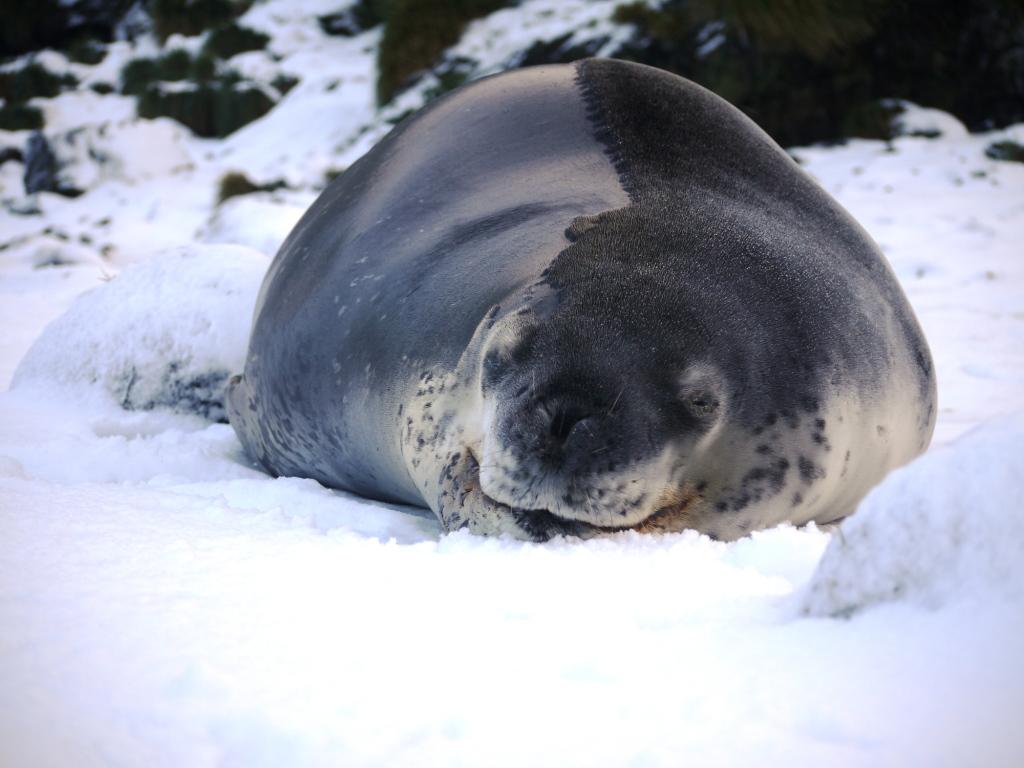
Now I’ve covered most of the birds, it’s onto the non-bird animals, namely the seals! It is continuing to be a good year for Leopard seal sightings. In May we sighted Leopard seals on 25 occasions, compared to last year’s four sightings. Each of the seals are given a name and in May we saw; Max, Paddy Boy, Stephanie (my name sake), Maurice, and Pearce. Hannah our resident seal expert has been out every day patrolling the beaches for sightings. Most of the time they aren’t particularly hard to spot lying on the beaches, or head standing (sleeping vertically in the water with their flippers sticking up). Sometimes we even get to witness them eating, which involves lots of splashing and failing about. It’s not only the human residents of the island who are on the lookout for them eating. As soon as the birds notice a kill they surround the seal trying to grab any pieces. It’s a fairly dangerous occupation but usually the seal is too busy eating to pay attention to the birds.  June was another productive Leopard seal month with 20 sightings. Pearce the seal was first spotted here 22 years ago when he was already an adult, that is one old seal! Hannah managed to retrieve a second GLS logger from a seal, which is very exciting as it is only the fifth to ever be retrieved. I’ll update with where they have been once the data is analyzed. 

Sleepy Leopard seal on the beach.

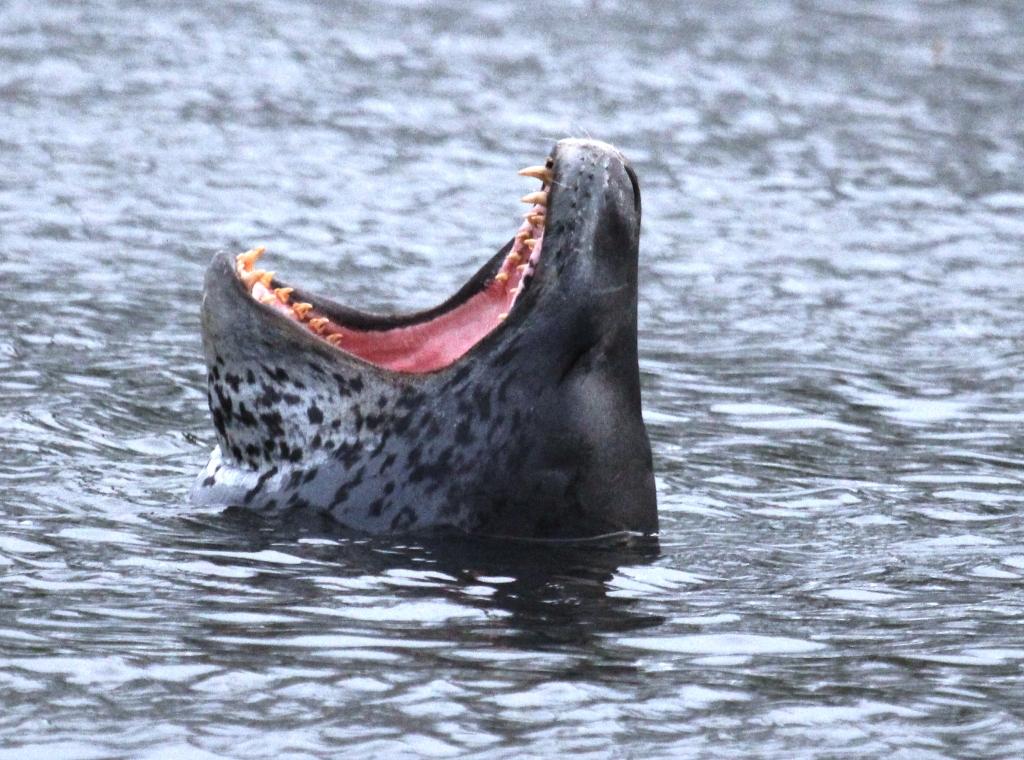
July has seen a few less sightings but in recent days the number have picked up again. This morning whilst sitting on the jetty a Leopard seal swam over looking at us curiously until a Fur seal jumped in the water and it took off after it. The seal got away as he was a bit too big for the Lep to handle. 
 
Maurice in the bay yawning (photo by Hannah Wood)
Antarctic Fur seal numbers have been increasing on the island again, with some of the big males returning to the island, after being at sea for a few months feeding up following the breeding season. You can definitely tell they are back from the smell! They have a very strong musky odour that you just can’t get away from when walking on the beaches. The numbers are still fairly small, we can still walk along the beaches without getting chased very much. 

A female Antarctic Fur seal
One of the less pleasant aspects of our job is to help seals that have been entangled in fishing gear. This week we were all involved in helping a young male that had a thick layer of parcel tape wrapped tightly around his body. After a bit of a struggle and getting  pretty soggy socks we managed to cut through the tape. The rest of it should now fall off when he is swimming. It’s very satisfying to remove debris from the seals, as in most cases the seal would die when it grew too big and the debris cuts into it. Happy story this time. I just wish people would think about what they discard into the ocean. 

Young male Antarctic fur seal after we had cut the tape from his chest.
The Elephant seals are still hanging out on the beaches lying on piles of rotting kelp. A couple of weeks ago we had our first large(ish) male. He didn’t have the typical big nose, but he was huge! Later in the season we might get some fully grown adult males (fingers crossed). 
The big elephant seal male with me for scale (Photo by Craig Brown).
Elephant seal relaxing on a bed of stinky rotting kelp.

Seals done, it’s onto whales. Usually by this time of year the Southern Right Whales have migrated north from this area, but for some reason they are still here. We have sighted them off the southern side of the island on a number of occasions recently. The easiest way to identify them when they are quite far out to the sea is by what the blow looks like when they breathe out. Southern rights have a V-shaped blow, which is very distinctive. They could possibly be around because of the higher than average water and air temperatures. Hannah and I saw one very close to the cliffs the other day but it wasn’t in the mood to perform any tricks and didn’t show us its tail. 

So mammals completed, it’s back to birds. Over the winter period myself and Jerry (the other bird nerd) count Snowy Sheathbill and South Georgia Pintails (ducks) every couple of weeks. The counts correspond with the highest tides, and we count the same area as was done last year. The reason for the counts is to assess if the rat eradication programme that was carried out this year is having any effects on the birds.  Duck numbers seemed very low, but all of a sudden the ducks have made a comeback, and they are often heard beeping (they have a very weird electronic beeping call) through the night. 

South Georgia Pintail duck- the only duck I know that eats meat and beeps.


Snowy Sheathbill scavenging on a Gentoo penguin carcass.


Friday, 5 April 2013

Winter is upon us


The start of March was time for final goodbyes to last year’s wintering team, the summer base commander and Iain the seal biologist.  None of us could believe how quickly the summer season had gone by, least of all the old wintering team who were on their way home after between 18 months and 2.5 years on the island! There were mixed feelings all round, I think everyone was sad to be leaving, and we were sad to see them go. However they are all moving onto news adventures; Tamsin is off to Namibia to work as a doctor, Jen is going to bike around the US, Central and South America, Jon is also off travelling in South America, and Ruth is off on a live aboard in Egypt. For us the new winterers although we were anxious about being left alone in charge of the base, we were also pretty excited about our winter and the more relaxed attitude to base life. 
moulting Gentoo penguins and Fur seals on a rare nice day

The Saturday before the ship was due to arrive, the new winterers cooked a meal for the departing team members. We even stretched so far cheese soufflé (which none of us had ever attempted before), and I made the cake that had so nearly defeated me on Valentine ’s Day with the complexity of the recipe (but this time I had help from Hannah).  The food all went down well and we spent the evening chatting, drinking and dancing. It turns out Iain is worryingly good at recent dance crazes like Gangnam style, and he gave us all a few lessons.  The following day was supposed to be the final day before the ship arrived, and luckily it was one of those rare beautiful days on Bird Island and we could even see the sun! Ruth took her first trip up Tonk, and came to me Jen and I over at the albatross colonies where we were doing some diet sampling. The views from the colonies of Willis Islands were just stunning. 

Mum and Dad at the nest
D-day finally arrived but when I opened the blind in the morning, mine and Hannah’s first thought was “It’s Christmas!!” . It had become a winter wonderland outside with a huge over night dump of snow, and it was still coming down.  Unfortunately though the wind had seriously picked up and it was at around 50 knots. We received an email from the captain of the Ernest Shackleton to say that they were stuck out in the open ocean in a Force 9 storm.  Glad I wasn’t on that boat! I did feel sorry for Jerry, our resident penguin biologist who unfortunately was on the boat after going to the Falklands to get his tooth fixed. So no boat that day! It was Wandering Albatross hatching time so I was visiting Wanderer Ridge study area daily to get the hatching dates of the chicks up there. I decided to go out and do my checks but the snow was as deep as my waist on the top of the hill. It made getting around very difficult, as although there was a lot of snow the bogs and ditches hadn’t fully frozen over, so on many occasions I would go through the snow straight into the cold muddy water that can be more than knee deep itself. I gave up in the end because of the 50 knot winds that I faced at the top of the hill, as well as ice crystals hitting me straight in the eyes. Sometimes it just isn’t worth it. 

The next day when I did manage to get up the hill I could barely see the Wandering Albatross sitting on their nests, as they were well camouflaged and half buried by the snow. They didn’t look too impressed by the snow and were all pretty grumpy after being battered by snow and wind for 24 hours. Quite a few eggs had hatched that day, a nice introduction to the world! Luckily it’s pretty warm under a Wanderers belly so they all seemed okay. 

The ship finally arrived two days late and I spotted it out in the mist while I was up the hill, but they decided that the weather wasn’t good enough to launch the boat to come ashore, as our little bay is pretty exposed and we get some big waves coming in, which can be very dangerous for the boat. Instead they decided to head off to King Edward Point (the next nearest base) to do the final call there. Another two days later the ship arrived back. They still had trouble with the water conditions, so sent in two zodiacs (small inflatable ribs) who brought us a few supplies including the post and a few vegetables. I took the crew up to Wanderer Ridge to meet some albatross which they all seemed to enjoy and had to hurry back down when they got a call from the ship saying that had to get back aboard. That evening Jen, Ruth, Jon, Tamsin and Iain all put on boat suits and headed off in the boats, and left the four of us standing on the jetty.... alone!

The next day the boats returned to bring us a few more supplies, including the rest of the vegetables! Thank goodness!  We managed to get rid of some of our rubbish and got all of the science samples away, which will give us a lot more space on base.  Finally the boats headed out of the bay for the last time, and it was officially the winter season. 

Wandering albatross displaying in the snow
Special thanks to my friends and family back home for sending me parcels and letters, especially Grandma and Grandad, Zara T, Zara S, Mel, Aunty Chris and of course Luke. You probably don’t realise how much it means to get post from home, but when you only get it three times  a year, it’s better than Christmas! 

 I didn’t feel as scared as I thought I might when the boat sailed off, not to be seen for another 7 months or so. Relief had been dragged out for so long that I think I was just glad it was over. 

It took us a while to get the base straight again, and all the boxes unpacked. The thing that takes the longest is sorting through all of the vegetables and fruit for insects. Bird Island doesn’t have any invasive insect species and we have to be really careful to ensure that we don’t introduce any. Everything seemed okay apart from the broccolis which were infested with caterpillars and moths! It took Jerry ages with a pair of tweezers and a magnifying glass to remove all of them and stick them in ethanol, to go back to Cambridge to be identified. 

March is a busier time in the albatross calendar than February, so with the loss of my partner in crime Jen and the increased workload I was finding myself pretty busy! Besides getting the hatching dates of chicks in the study area, I was making weekly visits to each colony to check for failed nests, doing fortnightly diet sampling, and I started weighing Black-browed Albatross chicks. All of the chicks at colony J needed to be weighed when they were exactly 80 days old, so it meant quite a few visits to the colony. The chicks weigh between and 3 and 5.5kg, if they have been fed that day it can add 1 kg to their weight so it’s pretty variable. The chicks get weighed every year and so long term trends can show how good food availability has been each year, and give an idea of the state of the oceans.

Weighing the chicks took its toll on me without me realising it, and on a trip up the hill one afternoon I started getting shooting pains in my back. A couple of hours later when I had managed to hobble back down the hill to base, praying that no seals would decide to attack me on the way, I was out of action for a few days. The repeated lifting of the chicks, even though they aren’t that heavy, really strained my back. I was pretty worried about it as for one day I was mainly laid up in bed, and after that I couldn’t see myself getting back up the hill in a while. Luckily I had Jerry and Craig to help me out with my work, and they weighed some more chicks for me and visited the Ridge. 

Sorry for all the Wanderer pictures but they are jsut too photogenic! This time with South Georgia in the background.
A few days rest seemed to do the trick and I was back in action for April 1st which is one of the more important days of the year for the albatross work, as it was the chick census day. Between us we had to visit all of the Wandering Albatross nests across the island and check whether there was a chick in the nest. In total we had 585 nests to check, and at the end of the day we had 504 left. This number probably sounds high but to put it into context only 10 years ago there were almost double this number..... Albatross are taking a huge hit at the moment due to long line fishing and climate change. I really hope they don’t keep declining at such a fast rate otherwise there might not be any left soon.  We had a beautiful day for doing the census which I was very grateful for as I don’t like sending people out to help with my work in the rain.
The next day was another busy one as it was the start of the week when all of the Black-browed Albatross chicks in the study colonies had to be ringed. I managed to get all of the chicks at colony J ringed, and the next day Jerry and I ringed all of the chicks in N. That adds up to around 400 chicks. It was a busy couple of days and my hand was sore, and my legs covered in bruises from the pliers. The rings are extremely hard stainless steel, so take all my strength to close. Pretty exhausting messy work (albatross chicks vomit a lot when disturbed). It was really satisfying to get it all done in a couple of days, even if I fell in a big ditch of muddy water on the way home and had to walk back with squelchy feet. 
Wandering Albatross chick with it's watchful parent keeping an eye on me.

Craig's birthday hot tub party (me, Hannah and Jerry)
It’s not all been work since the boat left, it was Craig’s birthday last week and we made the most of it. We had an Hawaiian themed cocktail party and BBQ (even though it was wet and cold) and Craig filled up our “hot tub” which is really an old water tank with the top cut off. It works extremely well as a hot tub (you do need ladders to get into it) and Craig rigged up some piping to the compressor to make us bubbles. We ended up staying in there for about 4 hours, as it was the first time in months any of us had been submerged in hot water (no baths here), and it was really cold outside. We drank champagne and listened to music... bliss!
Wandering Albatross family. Dad is having a good shake.

Saturday, 2 March 2013

Time flies when you’re having fun or when you are in the accelerated time zone of Bird Island


I realise that February has come and gone without a single post on the blog. I haven’t really got an excuse for that, I thought that nothing much had happened. However when I started thinking about it I came up with a fair list of stuff. With these things the longer you put them off the more monumental the task becomes, but as it is a rainy Saturday morning I thought it was about time I got something written. 

Towards the start of the month Jen showed me the final task that I hadn’t yet done, diet sampling. Every two weeks for around 3 months I have to take diet samples from 5 Black-browed albatross chicks and 5 Grey-headed albatross chicks. This is a very smelly job and you tend to end up very dirty. All the other base members know when you’ve been out sampling as the boot room ends up stinking. We definitely aren’t the only culprits for stinks in the boot room, seals and penguins have their own aromas. 

Once the samples are collected Jen and I have to sort through them and estimate the percentages of types of food in the samples. Some parts including squid beaks, fish otoliths (tiny round bones from fish ears), and krill are retained for me to attempt to identify in the winter. 

I’ve found it quite enjoyable doing some lab work, as it’s been a pretty long time since I’ve been in a lab! It makes a change from being out in the field every day, and it’s always good to learn some new skills. 

February has been a month of changes.  Since arriving on the island in November we had seen no sign of outside life, this month we have had two ship calls from the James Clark Ross. A ship call is a day of great excitement! The first one called in to collect Jaume (seal biologist) who had been on the island for four months. It also brought us a sack of potatoes and some eggs (a source of great excitement) and post! I received a parcel from one of my best friends Zara, which I really appreciated. I’d say post day is much better than Christmas at home, as no matter what it is, it’s great to hear from the outside world and to know people haven’t forgotten about the few of us living on this little rock in the middle of no-where. 
Jon's leg after the seal incident

The ship’s doctor came ashore to take a look at Jon’s leg which had been subjected to an unfortunate run in with a male Antarctic fur seal. We’d done our best to patch him up by administering some local anaesthetic then giving it a good clean out with a toothbrush and a lot of disinfectant. With bites, especially seal bites, you wouldn’t normally sew them up because of the amount of bacteria in the wounds. However in this case as it was a fairly big gash and just below the knee, the doctor decided it needed stitching. We had only been practicing our stitching a few days previously so the doctor let a couple of base members have a go including Jon himself! 

South Georgia Pipit
Just 10 days later it was another ship day! This time we lost Jerry who had been having some tooth issues and so has been sent back to the Falklands to see the dentist, he should be back in about 2 and a half weeks. From 9 original base members we were down to 7, but Iain, another seal biologist arrived to help out Hannah and Jon, so we were back to 8. Iain has a lot of experience of Bird Island as he wintered here some years ago when he was doing the same job as I’m doing, and he has been back on and off over the years.
The ship also brought us our first load of “freshies”- including lettuce, peppers, aubergine, bananas, oranges, grapes, avocados...... I won’t list everything but we were all thrilled after having no fresh veg for the last 3 months. It’s hard to imagine with the availability of whatever fruit or veg you could wish for in the UK, just how happy a few lettuces came make you. We also got four bags of post! I got a parcel from my grandparents and two parcels from Luke. I was very pleased with the high percentage of chocolate the parcels contained as well as photographs from home, and new music and films.  
Making friends with a seal pup

Last month it was the Gentoo chick weighing and census, this month it was the Macaroni penguins turn. It’s a bit different for the Macs as it would be impossible to count all of the chicks because of Big Mac- the largest colony on the island which has 40,000 pairs of Macaroni penguins. Instead Jerry and Ruth walk a transect through the colony counting chicks as they go.  For the chick weighing session everyone from base trudged over to Little Mac (the main study colony- of a much more manageable size),  apart from Jon who was looking after the base and his leg! We had to catch and weigh 100 chicks, and also issue them with a pit tag, which is the same as a microchip you would give to your cat or dog. The reason for the tags is that to access Little Mac colony the birds come through a narrow passage and have to cross the penguin weighbridge, that weighs them and scans their chips. To get the maximise use of the data we need as many penguins as possible to be chipped. 

February has been particularly exciting for me as the first Wandering albatross chick hatched on the 26th, after being incubated for 76 days. Of all the species on the island I have most been looking forward to the hatching of the Wanderers as I am going to get to spend the whole winter watching them grow up and finally fledge around December time. 
The first hatching Wandering Albatross chick.

Every day I have to go and check the nests to see which chicks have hatched, hopefully they should all have hatched in the next three weeks. For new born birds they are fairly big. They just about fit in my hand but won’t for much longer. 

Wandering Albatross family
This month we did a search and rescue exercise to make sure that we all know what we are doing over the winter. At first I didn’t realise it was an exercise, so when Jen radioed to say she had fallen and thought she had broken her ankle, I thought she meant it! After a couple of minutes I remembered that we were supposed to be doing an exercise that week and relaxed a bit. Craig and Hannah were sent to assess the casualty, whilst Ruth and I got together the stretcher and splints. We then headed over to the far end of Main Bay with the stretcher, which is extremely awkward and heavy to carry. We made it eventually after both nearly falling over on the rocks and managed to get a splint on Jen’s leg and her onto the stretcher. We practiced carrying the stretcher with just three people, as in winter that will be all we have. We managed it, but Jen is pretty light. If one of the guys is the casualty I don’t think we are going to be able to carry them back to base and will probably have to pitch a tent and await help..... which might take a few days. 
Search and Rescue exercise.

A panoramic view from the top of Tonk. On the left is Willis Islands, then La Roche and  South Georgia.
I’ve had a bit of spare time this month to do a bit of adventuring, and as we’ve had a few nice days I thought it would be worth getting up some of the peaks on the island. The first one was Tonk which I walk along the base of regularly. From the top you can see most of the island, apart from the bit behind La Roche (the highest peak). It was glorious being up there in the sun shine and with relatively little wind. I sat up there for a while watching the Wanderers and Light Mantled Sooty albatrosses wheeling past. I then decided to go and find a sooty chick as I hadn’t seen one before as they nest in fairly inaccessible places. Eventually I managed to find one. Sooty’s are renowned for being terrible are raising chicks. The vast majority of nests fail, so it’s a good job that they are so long lived otherwise I don’t think that they would last very long as a species. It was worth the look as the chick was very different to the other albatross chicks around the island, and looks as though it’s wearing a mask across its eyes. 
Light Mantled Sooty Albatross chick

The view from the top of Tonk, with base and La Roche in the background.
The second adventure was a trip up La Roche, the islands highest peak. It isn’t all that high by mountain standards at 356m but you get great views of the whole island and South Georgia. Craig and I hiked up in increasingly worsening weather, it started off fairly nice but was snowing before long. At one point we thought about turning back as it was really windy and there are some narrow parts to traverse with big drops below. We found a ridge to hunker down behind, had some snacks and decided to go for it. Fairly close to the top I spotted an Antarctic Tern chick, which was very exciting as they are not common things to find. I suspected there might be a chick around as the adults had been screeching at us most of the way up, but I hadn’t expected to find it! We made it up to the top and had fairly good views and a lot of wind. We took a short cut on the way back down, straight down the scree slopes which was fun but I wouldn’t have wanted to go up that way. 

Antarctic Tern chick

At the top of La Roche with South Georgia in the background on a very cold and windy day.


Sunset over Willis Islands
I guess more things have happened in February that I thought......