Saturday, 27 July 2013

April


The days have been getting progressively shorter on Bird Island since my last post. The sun doesn’t rise now until around 10:00am and has faded away by around 7:00pm. This is in contrast to when I first arrived on the island and it never truly seemed to go dark at all. We have to be increasingly vigilant to ensure that all of the evening checks are done before it goes dark, so we can ensure that no escaping light will attract Prions that could fly into the building and be killed (if not from the impact by hungry Skua’s). 

The weather is starting to chill down- an icy morning on the island
It has been another busy month workwise, and I have been out ringing all of the Grey-headed albatross chicks from colonies E and B, which totals around 200 birds. That is far fewer than the Black-browed albatross chicks, but still a substantial number to get through. Now that the ringing is complete I won’t have any chicks to ring until mid-August when it’s time for the Wandering Albatross chicks to receive their very own rings. 
Ringing a Grey-headed albatross chick

Other than ringing I have finally finished obtaining diet samples from the Grey-headed and Black-browed albatross chicks. I have a total of 30 samples from each species from the three months that their parents have been feeding them. I’ve analysed the main constituents i.e. amount of fish, cephlapod (squid), krill, carrion and other types of food.  Over the winter months I will be spending time in the lab identifying squid beaks, and fish otoliths to get the specific species that they have been eating.
Black-browed albatross chick almost ready to fledge


In the last week the Black-browed albatross chicks have started fledging. In a way I’m sad to see them go, but it’s nice to have seem them through from eggs, to increasingly large fluff balls, to fully grown smart looking birds. I expect in the next couple of weeks for most of them to be gone, which will be very strange. Although having been visiting the colonies on a daily basis, it will be nice to have a break from it, and time to do other things. 

Black-browed chick practicing for take off
The Grey-headed albatross chicks are a little behind in their development, even though they are older than the Black-brows.  Most of them still have quite a lot of fluff, and won’t be fledging for at least another couple of weeks. 

I’m hoping to see at least one chick fledge, as I didn’t manage to see any of the Wandering albatross chicks go this year. It isn’t an easy thing to predict though, and the chicks always seem to know when you are watching and suddenly become very shy. I’ve spent a fair bit of time watching them madly flapping their wings and jumping up and down, unfortunately most of them seem to face the hill rather than away from it, so I don’t think they’ll be going anywhere too soon. 

Gentoo penguin on a cold day
The Wandering albatross chicks have nearly all been left on their own, with both parents at sea gathering food for the insatiably hungry chicks. Some of the chicks clearly have very attentive parents as they have grown massively in the last few weeks. They must now weigh at least a couple of kilograms, in comparison to the approximate 300g they weighed when hatched. As you approach most of them sit up as tall as they can, with their feet sticking out in front of them. They still have a big round body with a thin neck and little head on top. At this age they are mainly all stomach, which they need to be as the parents can bring back 1kg of food at a time!
Wandering albatross chick

The number of penguins of the island has diminished to the point where it is fairly rare to see one. Craig and I managed to get a last trip over to Big Mac, the largest Macaroni penguin colony on the island (second biggest in the world). There were still a decent number of penguins around busy moulting and growing new feathers ready for a winter spent at sea. However it was no-where near the 80,000 birds that were there earlier in the season. We spent an enjoyable couple of hours sitting at the bottom of the colony watching the birds leaping out of the sea when the waves allowed and rushing forward onto dry land before another wave could catch them and pull them back in. Penguins are tough birds! The ferocity of the waves was unbelievable, and you would often see birds being tossed against the rocks repeatedly before managing to stagger out to safety. They seemed none the worse for it, and would spend a couple of minutes preening before joining the queue to head up to the top of the colony. That is one thing I’ve learnt about penguins, they are very English in their queuing habits! After a couple of hours of watching we decided we had better leave, especially after one of the big waves nearly managed to soak us up on the big rock we had been watching from. I certainly didn’t want to have a go at getting out of the sea like the Macaronis did, I would have had no chance. 

Macaroni penguins on their way into the colony
Only a couple of weeks later and I could only spot around 40 penguins on the whole colony, and we won’t be seeing any until the start of next summer in September, when they return to start the breeding season once more. 

Macaroni penguins trying to get back onto dry land
It is not only the penguins that have been disappearing, the seal pups have all gone. Over a period of about a week I noticed that instead of seeing pups everywhere, there were suddenly hardly any left. They are about three or four months old now and have finally felt the urge to head out to sea where they will learn to feed themselves. The females have been returning to find their pups gone, and hang around for a couple of days to see if they come back. Before long the females will depart too leaving a very quiet beach.  

The winter brought us our first storm, which meant a day inside at the wind was very strong and huge waves were driving into the bay and crashing high up on the rocks. The next morning the wind had died down but masses of seaweed had washed up onto our beach. It was over a metre deep in places, and was making life difficult for the penguins that had been on the beach overnight. They struggled to get back to open water clambering over the kelp, and continuously getting it wrapped around their legs and falling. The seals on the other hand seemed to like their new comfy bed, and looked at home curled up on the seaweed. 

On one of our trips to the albatross colonies Jerry and I found lots of washed up marine life on Evermann beach. There were numerous types of starfish, sea squirts, strange looking cephlapods (they look like aliens!). We bagged up a few samples to bring back to base to try and identify. Whilst hunting through the seaweed for interesting specimens I came across a bird ring that had probably washed up in the storm. It was an old American ring, which were the first type used on the island, so I knew it was going to be old. It turned out that the ring had been put onto a Black-browed albatross back in the 1961/1962 season! Who knows how long it has been in the sea, but it’s a good find. 

Variety of Starfish washed up on the beach after the storm
Giant cephlapod washed up on the beach (very alien like)
Hannah and I went out to check how the Light-mantled Sooty albatross chicks were doing, but unfortunately we couldn’t find a single one. They are still more nests to be checked but it isn’t a good sign. The Sooty’s tend to have the worst reproductive performance of all the albatross species’ that we have on Bird Island. It is still disappointing to find empty nests where there were once chicks. On the way back from checking the nests we ventured up to the only accessible cave on the island. It isn’t very big but you could sleep in there if you wished as it was fairly dry at the back. We might have to try it out over the winter. 

Light-mantled Sooty albatross hanging out in the Grey head colony
Star Wars day
Socially we haven’t had a particularly busy month, but we did have another BBQ and hot tub evening, as well as celebrating Star Wars day on the 4th May. We all dressed up as characters from the film, had a nice meal, played cludeo, and watched the fan made version on Start Wars episode 4.

I apologise for the delay in updating the blog, but the internet here has been really slow over the last couple of weeks. I will attempt to get another update done soon, as lots of exciting things have been happening (Leopard seals!)

Friday, 26 July 2013

Tsunami's and Leopard seals- a dangerous combination


From the beginning of May Hannah (seal scientist) has been on the look out for leopard seals. They only come to Bird Island during the winter season as they prefer cold weather. Every day when I went to colony H Black-browed albatross colony I would scan the beaches to see if I could spot one, but no luck. After spending 6 months on the island it felt strange that a “new” species might turn up, so I was never really expecting to see one. One afternoon I was over at colony E (the other side of the island) weighing some Grey-headed albatross chicks with Jerry when I heard a radio message from Hannah saying that there was a leopard seal on Main Bay, and it was huge! I had a busy day ahead of me checking my various colonies so I was praying that it was a tired leopard seal and would still be napping on the beach a few hours later.
A panoramic view from up the hill, a site I see almost every day

I actually had a really enjoyable day, mainly due to the nice weather, and after visiting the usual colonies headed over to a new part of the island. Every year we have to count the Grey-headed albatross chicks in certain colonies to see how successful a breeding season it has been. One of the colonies I had never been to before so it was a bit of a guessing game trying to figure out which group of chicks I was supposed to be counting. To get there I had to head out onto Johnson point which is not somewhere I usually have to go. I had to walk down the stream (which was useful as I found a couple of ringed Black-brow chicks that hadn’t made it) and up the hill towards the end of the island. It was nice to see the areas I usually spend my time in from a different perspective. 
Wandering albatross family- the chicks are getting big!

From the end of the island I saw lots of different birds including; giant petrels, all four albatross species, Cape Petrels, Skua’s and lots of Blue eyed Shags. It’s nice to see the Wanderers out amongst the waves, gliding effortlessly in between waves, and somehow never managing to get splashed. I had a brief sit down and had a snack whilst taking in the bird life and watching the waves pound the coastline. 

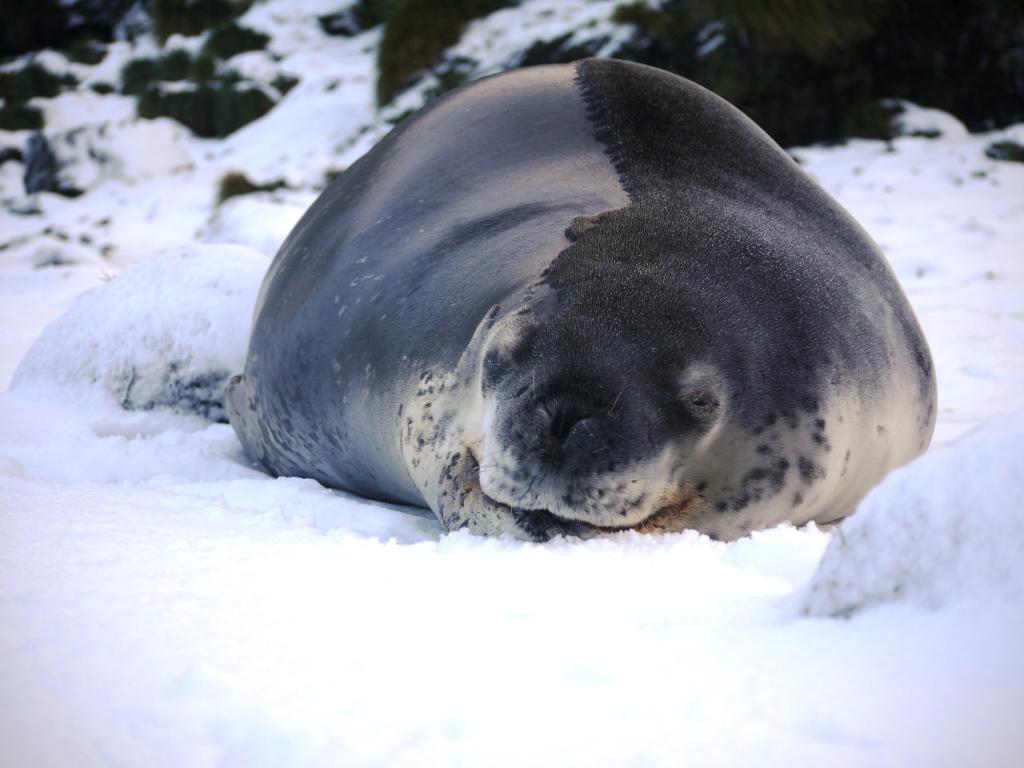
It had been a few hours since I heard about the leopard seal, but luckily for me it was still lying on the beach. From up the hill it looked like a huge smooth grey rock, but when I got a bit closer I could make out some flippers and a head. It was fast asleep lying on its side. I took a few photos but didn’t want to get too close and only had my compact camera with me. Hannah came over to do some more observations so I left her to it, and headed home after a long day. 

Max the leopard seal
The seal already had flipper tags, so we knew it was one that had been at the island previously, and it also had a GLS tracker attached to one of the tags. Hannah managed to get it back, which is very exciting, as it is only the fourth tag retrieved in 10 years. Not much is known about where these seals spend the rest of the year, so every tag retrieved provides valuable data. 

Leopard seals can be identified from the patterns of spots and markings on their skin, so Hannah has to take photographs of all the seals she sees and uploads them to a database to be identified.  The seal seen was identified as Max, a young male leopard seal, who had been seen at the island last year. He didn’t look like a young seal to me as he was huge! Over 3 metres long with a huge powerful head. 

The following day he was spotted out of the water again, so I headed over to take some more photographs, and I got to help Hannah measure him, which you do when he is asleep. He kept waking up because a Sheathbill kept pecking at a big wound on his back (which could have been caused by a male Antarctic Fur seal. It looked very sore, and he was not impressed by the bird, but couldn’t quite manage to grab it before it ran away. 

Max getting annoyed at a Sheathbill that is making a hasty exit
Since then Max has been seen in the water a couple of times feeding. It is obvious when he has made a kill as he is surrounded by a cloud of Giant Petrels and Cape Petrels, looking to grab a piece of his leftovers. It is hard to tell what he is eating as it’s usually below the surface, and leopard seals have a tendency to turn its prey inside out to eat it more easily. It seemed most likely that he had a young fur seal, and possibly a penguin on another occasion. 

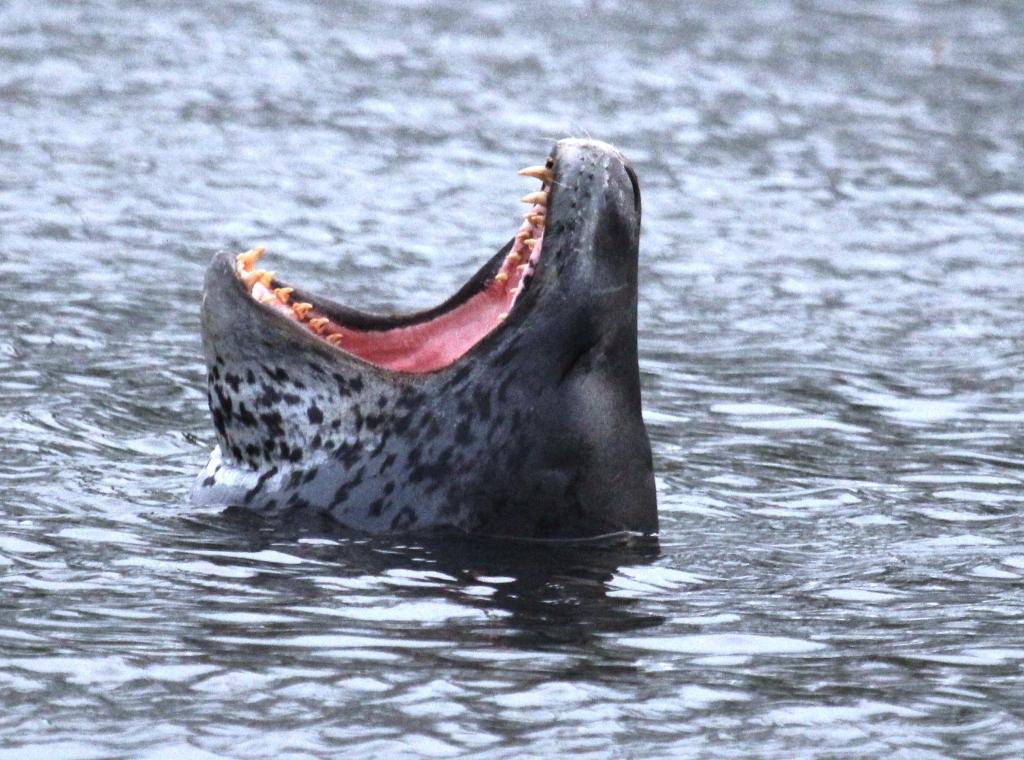
Max showing just how big that mouth is- apparently they have a head bigger than a Grizzly bear
A few days after the first sighting of Max, another leopard seal turned up. At first we thought it was Max as it was seen in the same area that he had been feeding in. Looking back at the photos taken Hannah noticed that there was a distinctive S shaped marking on its face. It was definitely not Max. Looking back through the records the seal was identified as Stephanie; a female seal that had first been identified on the island in 2007. I haven’t yet seen her myself but I am hoping to see her soon. 

Leopard seals are not the only exciting species to have been spotted this month. Hannah spotted a Southern Right Whale while doing her daily Leopard seal rounds. It was showing well so I went up to join her and watched it for around half an hour feeding just off the island. Southern Right Whales can be up to 16.4 metres long and can weigh as much as 30 tonnes. I’m not sure how big the one we saw was, as it is hard to estimate but it looked pretty big. Earlier in the season they were spotted regularly around the island, but this was the first individual seen for some time. All records of whales are noted down for our annual report. In other years Killer Whales have been seen off the island, but very rarely.  

South Georgia Pipit
All of the Black-browed Albatross chicks have now fledged, and it is the turn of the Grey-headed Albatrosses. The first chick disappeared on the 14th May, and I will be checking the study colony every day until the last one goes (which could be as late as the 17th June). The mortality rate seems to be higher than the Black-browed Albatross chicks, and recently I have been finding dead chicks which when weighed only a few days previously seemed healthy. The only explanation seems to be that Giant Petrels and Skuas are killing chicks, as there is very little food around for them. On the last two occasions that I have been to the colonies I have seen both Giant Petrels and Skuas feeding on dead chicks. Hopefully a good proportion of the remaining chicks will fledge soon, and not become dinner for the other birds. 

Fully grown Giant Petrel chicks- smart birds!
Last week we had an unusual start to the day when the emergency phone started ringing early in the morning. I jumped out of bed to answer it and it was Les back in Cambridge. He was phoning to tell me that there had been a tsunami alert for South Georgia, and it was due to hit in 20 minutes. We had to evacuate the base (which is on the beach) and head to higher ground. I quickly woke everyone up, and we all got kitted up in warm clothes and headed up the hill to wait. It was pitch black outside so we all took torches, and once we had gotten far enough up the hill we sat down in the snow to wait. We had taken an iridium (satellite) phone with us, so we could call Cambridge when we were in a safe place. In the end we stayed up the hill for around an hour before being allowed back down to the base. Luckily the tsunami didn’t materialise, but it was still a scary few minutes when we were getting ready to leave the base. We later learned that there had been an earthquake in the South Sandwich Islands which was fairly shallow, and so could have triggered a tsunami. 

Another task this month was to go and check all of the Light-mantled Sooty Albatross nests that had been found earlier in the season to see if the chicks had survived. It was dire news though, not one chick was found out of an initial 75 nests. It’s hard work to check the nests as they tend to be on cliffs around the coastline which are not easily accessible, and requires you to battle the huge tussac grass. A few months ago I did the same survey with Jenn, to check if the nests had progressed to having chicks. It wasn’t all bad though, as it was a lovely cool frozen day, with nice views of South Georgia. I hadn’t been over to that side of the island for ages, so it made a welcome change. 

View over to South Georgia whilst doing the Sooty census
The number of skuas across the island has been decreasing over the last couple of months. We used to have large numbers of them on the beaches, and you would see them  constantly washing themselves in the streams. They seem to have a serious case of OCD when it comes to bathing! Recently though we only have a few left that hang out around base. One of them is likely to be a permanent resident as he has an injured wing which doesn't seem to be getting any better. He waits outside the door for you and then follows you around hoping to get a bite to eat. Sometimes he's lucky and we are taking the "gash bucket" (slops bucket) out, and he often gets first dibs. We have called him Scratchy, as has very sharp claws. I learnt that when we were examining his injured wing and he managed to slice my finger open.

Scratchy the resident Skua
This month we have been recreating the television programme Come Dine with Me. Each Saturday it is the turn of another Bird Island resident to prepare a three course meal and entertainment for the others. Craig is hoping to make a film out of it once we've finished. The last "episode" is this Saturday, so I'll let you know how it all goes.


Gentoo penguins having a disagreement, the one on the left had walked up and yanked the tail of the other one.


Thursday, 25 July 2013

Birds, birds, birds!


I realise that I’ve been absolutely awful at updating the blog recently, which I apologise for. Even though we are now in the middle of winter, I’ve been pretty busy. A fair amount of things have happened in the last month and a half. I’m going to split it up into different sections, so this isn’t just one mammoth post.
The first one is going to be about the birds on the island.

 There has been even more change with the complete departure of the Grey-headed Albatross chicks. They finished just before mid winter on the 20th June. Compared to last year they were fledging a lot later, which meant more daily trips to the colonies. It was strange going up to colony B for the last time which overlooks Big Mac penguin colony. Both were completely empty and silent; so different from the main season when the noise of the penguins can be heard over a kilometre away, and the albatross chicks are begging for food, and the adults are chattering amongst themselves. However although I was a little sad to see the place so deserted, as least the chicks that have left the island are hopefully beginning what could be a long life roaming the oceans and returning to the same colony in a few years to breed. In around three months time the adults will be back for another few busy months of chick rearing. 

Wanderer chick practicing flapping.
The only type of albatross now left on the island is the Wandering Albatrosses. The chicks are growing rapidly in size and some look almost bigger than their parents. The chicks will end up weighing more than their parents, and will lose their baby fat just before they fledge, so they can actually get off the ground! I often see the parents returning to feed the chick hearty meals of fish and squid. They get fed on average once a week, with the two parents flying potentially thousands of miles between feedings. 

Once a month everyone on base goes out and checks on all of the chicks across the island to check for failures. The last couple of months have had very few failures, this is because the chicks are now so large that the other predators (Giant Petrels/Skuas) are too small to be able to take them on (unless they are injured or sick). The main reason for failure is if one of the parents is killed by a long line fishing boat, and the other cannot usually manage to provide enough food and the chick starves. We have one chick that this has happened to named “Tiny Tim”. Since April Tim has been much smaller than the other chicks surrounding him. I’ve been expecting to find him dead every time I visit, but somehow he keeps surviving. It’s now mid July and he is still alive and has gotten a little bigger, but is very under weight for his age. It has been known for small chicks to fledge, so I’ve got my fingers crossed that Tim is going to be one of the lucky ones, and his one remaining parent keeps doing such a good job. I’ll keep you updated with how he does. 

One of the other more notable Wanderer chicks is Scruffy chick. Whilst I was doing this month’s checks on the chicks I realised that one was missing. I found the empty nest and presumed the chick had died and been dragged off as a tasty snack for a Giant Petrel. I began searching though the tussac grass to find the body when I suddenly spotted the head, which moved! As I approached I realised that the chick seemed to be below ground level, it looked very strange. When I got to the chick all I could see was its head and a little bit of its back down a deep hole in the ground. The chick was still alive but was pretty weak, it barely had the energy to try and defend itself from me.  I dug out some of the soil that had fallen onto the chick and eventually managed to get my arm underneath the chick’s breast to try and pull it out. The chick was well and truly wedged down the hole, which was full of sticky mud and it was not giving the chick up easily. After about 15 minutes I managed to heave the chick out and lay flat on my back holding the chick, both of us exhausted from the exertion. The poor chick was soaked to the skin in mud, and seemed to have a leg injury. I don’t know how long the chick had been down the hole, but it must have been quite some time, and through its struggling it had twisted its leg in a funny angle. I wasn’t sure if the leg was broken but it didn’t look good. I put the chick back on its nest where it lay flat exhausted. It was a pretty distressing experience for both of us, but at least he wasn’t going to die half buried under ground. As soon as I left the chick I saw a Giant Petrel land next to the nest. It’s amazing how quickly they can spot weakness. 

Scruffy Wanderer chick a few days after rescue.
A few days later I went back to check on the chick with Hannah. I was fully expecting to find him dead, but miraculously the chick was still alive and trying to hide underneath some tussac. Wanderer chicks generally feel safest while sitting on the nest mound, as they can see all around them, and it was the place that they were born. This chick clearly was very scared and was trying to hide under the grass. Hannah and I made some improvements to his nest, by adding pieces of grass to the nest cup and then placed him back on top. He immediately perked up and started busily rearranging his pieces of grass so they were comfy. The injured leg looked a lot better, and he was able to sit up and put weight on it. It still doesn’t look perfect but I have a lot more hope for his future. He was waggling his tail feathers and making contented noises to himself. I’ll keep going back every week to check on him and you never know he might recover. 

Adult Wandering Albatross back to feed its chick.

On the penguin front there are only Gentoo penguins around now. Not in as big numbers as in the summer months but there are often a couple of them on the beach in front of base, and bigger numbers on the breeding beaches. Unfortunately for the penguins the Leopard seals have taken a liking to the taste of them and we’ve found a couple injured on the beach. I’ve been working on my penguin calls but I’m not very good. Sometimes I can get a response, I’ll keep working on it. 

It’s not only penguins that are becoming seal snacks, in the last week we’ve found two dead Giant Petrels that have been munched. This isn’t unknown but we definitely see less of it, there isn’t a massive amount of meat and you would have thought they’d have more chance of escape being able to fly. 

In Skua news there is now only one Skua on the island- Scratchy our adopted pet Skua. All of the rest has left for South Georgia and more food, but with his broken wing Scratchy has to remain here with us. He spends his days hanging around the kitchen door, taking copious baths in the stream (we think he has OCD) and sleeping. The rest of the Skuas probably won’t be back until September ready for the seal pups being born and a ready food supply on hand. Mmm placenta! 

Scratchy ice skating.


Non-bird animals (oh and a few birds)


Now I’ve covered most of the birds, it’s onto the non-bird animals, namely the seals! It is continuing to be a good year for Leopard seal sightings. In May we sighted Leopard seals on 25 occasions, compared to last year’s four sightings. Each of the seals are given a name and in May we saw; Max, Paddy Boy, Stephanie (my name sake), Maurice, and Pearce. Hannah our resident seal expert has been out every day patrolling the beaches for sightings. Most of the time they aren’t particularly hard to spot lying on the beaches, or head standing (sleeping vertically in the water with their flippers sticking up). Sometimes we even get to witness them eating, which involves lots of splashing and failing about. It’s not only the human residents of the island who are on the lookout for them eating. As soon as the birds notice a kill they surround the seal trying to grab any pieces. It’s a fairly dangerous occupation but usually the seal is too busy eating to pay attention to the birds.  June was another productive Leopard seal month with 20 sightings. Pearce the seal was first spotted here 22 years ago when he was already an adult, that is one old seal! Hannah managed to retrieve a second GLS logger from a seal, which is very exciting as it is only the fifth to ever be retrieved. I’ll update with where they have been once the data is analyzed. 

Sleepy Leopard seal on the beach.

July has seen a few less sightings but in recent days the number have picked up again. This morning whilst sitting on the jetty a Leopard seal swam over looking at us curiously until a Fur seal jumped in the water and it took off after it. The seal got away as he was a bit too big for the Lep to handle. 
 
Maurice in the bay yawning (photo by Hannah Wood)
Antarctic Fur seal numbers have been increasing on the island again, with some of the big males returning to the island, after being at sea for a few months feeding up following the breeding season. You can definitely tell they are back from the smell! They have a very strong musky odour that you just can’t get away from when walking on the beaches. The numbers are still fairly small, we can still walk along the beaches without getting chased very much. 

A female Antarctic Fur seal
One of the less pleasant aspects of our job is to help seals that have been entangled in fishing gear. This week we were all involved in helping a young male that had a thick layer of parcel tape wrapped tightly around his body. After a bit of a struggle and getting  pretty soggy socks we managed to cut through the tape. The rest of it should now fall off when he is swimming. It’s very satisfying to remove debris from the seals, as in most cases the seal would die when it grew too big and the debris cuts into it. Happy story this time. I just wish people would think about what they discard into the ocean. 

Young male Antarctic fur seal after we had cut the tape from his chest.
The Elephant seals are still hanging out on the beaches lying on piles of rotting kelp. A couple of weeks ago we had our first large(ish) male. He didn’t have the typical big nose, but he was huge! Later in the season we might get some fully grown adult males (fingers crossed). 
The big elephant seal male with me for scale (Photo by Craig Brown).
Elephant seal relaxing on a bed of stinky rotting kelp.

Seals done, it’s onto whales. Usually by this time of year the Southern Right Whales have migrated north from this area, but for some reason they are still here. We have sighted them off the southern side of the island on a number of occasions recently. The easiest way to identify them when they are quite far out to the sea is by what the blow looks like when they breathe out. Southern rights have a V-shaped blow, which is very distinctive. They could possibly be around because of the higher than average water and air temperatures. Hannah and I saw one very close to the cliffs the other day but it wasn’t in the mood to perform any tricks and didn’t show us its tail. 

So mammals completed, it’s back to birds. Over the winter period myself and Jerry (the other bird nerd) count Snowy Sheathbill and South Georgia Pintails (ducks) every couple of weeks. The counts correspond with the highest tides, and we count the same area as was done last year. The reason for the counts is to assess if the rat eradication programme that was carried out this year is having any effects on the birds.  Duck numbers seemed very low, but all of a sudden the ducks have made a comeback, and they are often heard beeping (they have a very weird electronic beeping call) through the night. 

South Georgia Pintail duck- the only duck I know that eats meat and beeps.


Snowy Sheathbill scavenging on a Gentoo penguin carcass.