Saturday, 24 November 2012

The long journey south- part 1


Getting to Bird Island is not an easy feat. It starts with travelling to Brize Norton RAF base near Oxford for a flight to the Falkland Islands via Ascension Island. The RAF like you to be there extra early, so I arrived about 5:30pm for a 11pm flight. It’s very different to a normal airport in that you have to get a security pass to get into the place with your picture on it. Once inside the terminal some things are the same, you still get the baggage trolley and queue up to check in (luckily I was just under my weight limit so didn’t have to pay any extra!). Other things are not the same, there were lots of soldiers in the airport, as there was due to be a flight in Camp Bastion, Afghanistan the same day, there is no duty free, or really any other kinds of shops (apart from a Spa). There is also no Wetherspoons (which seems to be a staple in most airports these days), because it is a dry airport (not sure if that is because they don’t want the soldiers having a few too many before flying or what).

The flight left just after 11pm and much busier than I expected. The plane was 8 seats wide and most of them were taken. It was fairly comfy and we were served snacks and orange squash (again a dry flight). Not long after take off they came around with ipads for all of us with films to watch. That was really surprising after being served orange squash for drinks, but hey ho! The flight was around 7.5 hours and then we landed in a slightly damp Ascension Island. We were only there for an hour and a half and were kept in what could only be described as a cage in the airport. I was really looking forward to my last bit of sunshine, but disappointingly it was over cast and a bit damp. 


After the plane had been refuelled we all got back on for the next 8 hour flight to the Falkland Islands. We arrived at Mount Stanley to glorious sunshine, which I really wasn’t expecting! Outside the airport we stripped down to just t-shirts (I’d packed a hat and gloves in my hand luggage ready for arrival- but I definitely didn’t need them). From the airport it is a long drive to Port Stanley (the capital of the Falklands), not because of distance but because of the lack of proper roads. Our journey was made longer when we had to stop because part of our bus was dragging along the road! Eventually the offending piece was ripped off and we continued on our journey and eventually made it to Port Stanley and our ship. 

The view while we waited for our bus to be fixed. That is the main road between the airport and Stanley!

Time to go.


So after months of preparation it is finally time to depart the UK for Bird Island. I’ve packed and repacked and hopefully I haven’t forgotten anything that will be imperative over the next 16 months, as there are no shops for me to pick up anything!

Over the last few weeks I have been very busy moving house, temporarily re-homing our two cats, finishing everything up at work, and saying goodbye to friends and family. In the last couple of weeks I’ve been to Blackpool, Halifax, York, Clitheroe, London, Dorking, and Cambridge. Although it’s been busy it has been really great to see friends and family before I leave. I’m going to miss a lot of people. I’ve also been taking advantage of all the food that I probably won’t be able to get out there including Nando’s, Thai, Indian, and I’ve also been to the cinema a couple of times to get my final big screen action for a while!

All there is to do now is say goodbye and see you all in 16 months!

Let the adventure begin!!! :D

Friday, 12 October 2012

Extreme First Aid and a few squid

After finishing the field course in Debyshire I had a day in the office learning about identifying squid beaks (not such an easy task), which is a vital skill for my job as I have to identify what the albatross have been eating from diet samples.

The albatross can't really digest the squid beaks (the only hard part of a squid) so tend to regurgitate them. It is then my job of gathering them up and figuring out which is which species. I've included a picture of a squid beak so you know what I am talking about (the ones I'm looking at are a lot smaller as albatross can't eat squid that big!). Luckily for me I had one of the Antarctic squid beak world experts as my teacher who has even handly written a book with lots of pictures to help me! Thanks Jose!


I wasn't back in the office for long and headed down to Plymouth for the advanced first aid training course at the hospital where all of the Antarctic doctors are based. There were only 8 of us on this course, and I was the only one from Bird Island so the pressure is definitely on me if anything does go wrong on the island (I'm just hoping I'm not the injured one!).

The course was over three days- the first was a recap of CPR and assessing a casualty, we spent the afternoon discussing the best drugs to give to people (and how much), using machines to monitor heart rate, oxygen saturation and blood pressure, and gluing and sealing up wounds.

The second day was extracting casualties from vehicles and then we got to practice our new skills on a more realistic dummy than the resus Annies (which are just a torso and head you can breathe into and do compressions on). This dummy speaks, breathes, has pulses, blinks, swells, shakes, pupils dilate, everything!

Our dummy
We were given scenarios and had to go into the room and get on with it! There was a window with one way glass so the doctors could see what we were doing, and they had computers that could tell them how much oxygen we were getting into the patient, and how effective our chest compressions were. It seems the most important thing to do for most situations is check the airway and give them oxygen. We played through a variety of scenarios including anaphylactic shock, heart attack, chainsaw wound, damaged lung. At the end of the day we all felt more confident and had a great time in the process.

The dummy having a bit of extra oxygen and keeping his head supported in case of spinal injury

The dummys control room- where the doctor can make him do all sorts of interesting things like go into cardiac arrest! They can also watch us through the one way glass.

The dummy when he was feeling a bit better!
 On the final day we learnt to put plaster casts on (only for ankles and wrists- so I hope no one breaks anything else!). It was the first time I'd had a cast on in my life! The wrists are definitely easier to do than the ankles.

We then went into A&E for a couple of hours, where we got to wear scrubs, so looked like real professionals! I was just hoping people wouldn't ask me too many questions being a fake doctor and all!

It was really good to be in A&E watching how the department works. Within a few minutes of being there we heard a cardiac arrest was coming in, we were asked if we wanted to come into the resuss room to see how it all works. We agreed, and before we knew it Daniel and I were deciding who was going to go first with the chest compressions! Talk about being thrown in at the deep end! We waited nervously for the patient to arrive, and then took our turns doing the chest compressions in between shocks from the defib. It was certainly an experience, and I'm really glad I did it as I now know what it's like to do it for real.

After that dramatic start to our shift we followed the doctors around and saw an eye injury, assessed a man with chest pains (we got to do his blood pressure, pulse and oxygen saturation measurements) and looked at some x-rays of a broken wrist.

All that was before lunch! In the afternoon we learnt how to inject local anaesthetic and suture (stich), which was quite enjoyable- I think it helps that I have done sewing before. We also learnt how to put a cannula into someones arm, starting off with a fake arm that was wired up to some "blood", and then got to practice on a real victim (I mean patient). I couldn't get any blood out of my first patient but was successful with my second. We also got to see a "bone gun" which looked a very scary torture implement and is used to put fluids/drugs direct into your bone marrow (thankfully we didn't have to practice that one on each other).

Stitching practice- luckily not on each other.

The arm! We used this for practicing putting in a cannula, it has it's own blood supply so you can actually get blood out of it.

All in all it was an amazing course, and I came away thinking I may have chosen the wrong career- but I didn't hold that thought for too long. I can't wait to get out and see those albatross on Bird Island, less than a month to go!

Wet and windy Derbyshire- just like Bird Island!

Before we head off to Antarctica BAS want to make sure that we are at least slightly competent in looking after ourselves out in the wilderness. To ensure this is the case we were sent up to Derbyshire for a three day field course to learn all sorts of useful skills.

Apparently last year the weather was really nice, this year we had the worst September storms for 30 years.... It rained and it rained and it rained for the entire time we were there, apart from a couple of dry hours one morning. It really was quite realistic for those of us going to Bird Island, where it is wet and windy most of the time, but not so good for the guys going to Halley or Rothera where it doesn't really rain as it's too cold.

First we were taught how to light the Primus stoves (which looked like museum pieces, but apparently nothing better has been invented in the last 100 years) and the Tilley lamps (to keep us ultra warm in the tent). We had a session on rope work- how to tie in, tie together and walk with a rope between you (in case one of you falls down a big crevasse), then dinner and pub.

The following morning we were up early getting the stove on for a hot drink and had a sandwich production line going. We headed off to the Crag and it started raining almost immediately (that was the dry part of the course). We all took turns abseiling down a cliff and then jumared back up to the top. Jumaring is climbing up a rope using two metal clamps that you can use to hold you in place then slide up as you climb higher. You are supposed to use the strength in your leg to push yourself upwards. I found it pretty hard, but got to the top eventually with a few bruises.

Going over the edge- it was pretty windy up there!

Our campsite- more like Glastonbury!


 Search and rescue is an important skill to have working in such remote locations, so we learnt the theory and then put it into practice using "white out" goggles. It was fun but did require team work and clear leadership. We managed to find all of our missing people in the end, except for the one lost in tussock (but it wasn't too realistic to conditions we have on Bird Island- so we should have found them really).


Search and rescue team

Bird Island team doing blind search and resuce (Chris, me, Hannah and Jerry)


The Islands group were the last to leave the crag, which we were all very proud of, as we are clearly the most hardcore group, or maybe just foolish! It was Hannah's birthday so we had a tasty dinner followed by cake and pub (again).

Happy Birthday Hannah!
The next day we did some navigation and more search and resuce, followed by a demo on how to get someone out of a crevasse. It involved lots of pulleys and knots, but looked very impressive. I think we will be going over a lot of the things we learnt when we are on the island, so we don't have to remember everything first time.

We ended up leaving a day early due to the weather, I was glad in the end as our tent proved to not be waterproof and I had a nice pool of water underneath my sleeping bag on the last night in the tent. Everyone was suprisingly cheerful, which goes to show they definitely have the right people for the job!


Sea survival training

On Saturday after the week at Girton college all of the people travelling to Antarctica by ship had to be up and ready for 6:30am to head off to Lowestoft for sea survival training.

This was the training I was least looking forward to, not only becuase of the very early start but because of the prospect of having to jump from a large height into water (which is really not my idea of a good time). There were various rumours going around about the height we had to jump from ranging from 6-10 metres. I was definitely hoping it wasn't 10.

We arrived at Lowestoft and launched into a three hour powerpoint session about lifeboat operation, when to abandon ship and how best to survive in a life raft. A lot of it was fairly technical and probably not that relevant to us, as I hope the ships crew will be lowering the lifeboats if we were sinking and not me! The information about how to survive in the life raft was good though- no water or food for 24 hours, how to keep warm, and how to signal for help.

After the classroom session was over we had lunch just in time for the pool session. We changed into attractive orange boiler suits (looked very much like Guantanamo bay prisoners) and rubber shoes, donned our lifejackets, and then it was time to get wet. Luckily we didn't have to jump from 10 metres but it still looked mighty high (even though it was "only" 3.5 metres above the water). The pool was 4 metres deep so when you looked down it was nearly 8 metres to the bottom which looks very high when you have to jump into it. We were told that we had to make sure we held our life jackets down with one hand so they don't ride up and hit you in the face, or dislocate your shoulder, and one hand over your nose and mouth.

When it was my turn to jump I closed my eyes and after a few seconds deliberating jumped. You definitely had time to think about falling and worry about whether you were holding the life jacket correctly, but it wasn't as bad as I expected.  However it wasn't over yet!

The next stage was to jump again but this time in the dark (which was fine as I had my eyes closed anyway), you just had to be careful not to jump on top of anyone! We then practiced clambering into life rafts, and righting an upside down raft on your own, followed by being winched up from the pool (like you would be by a helicopter). Once they decided we were competent they turned the storm on... this time we had to jump into the pool which now had 2 metre waves, rain and a gale! A bit more realistic!

We were then told to take our lifejackets off and thought it was the end, but oh no, this was the real practice. This time the lights went off and the abandon ship order came across the tannoy, we had to get upstairs, get our lifejackets on and get off the ship all in the dark (with a few lightning flashes). Once you were in the water you had to swim for the raft, which was being thrown all over the pool by the waves, all get in (easier said than done) and batten down the hatches. As I was heaved into the life raft I found myself face down underwater in the life raft! I've never heard of drowning in the raft before, but it was a scary few moments as I tried to get my head above water, while my feet were still up on the side of the raft, and people were sitting on me. We had a bit of trouble figuring out if we were all in the raft, but luckily everyone made it safely!

We all got a shiny certificate and are fit to go to sea!  


Training, training, training!

Over the last few weeks I have been doing lots of training courses prior to being shipped off down south on the 11th November.

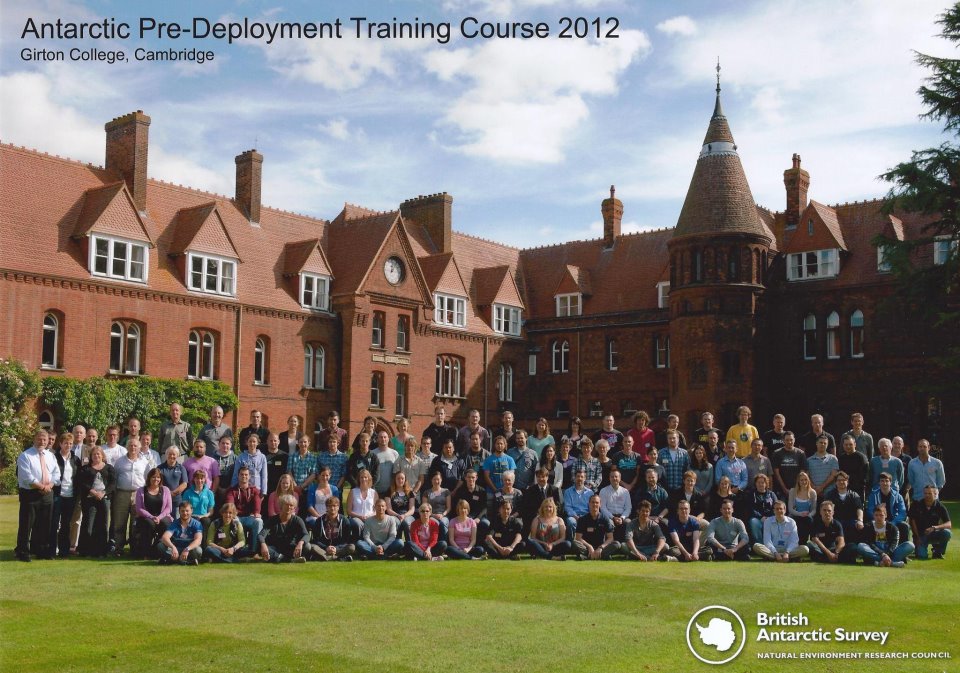
It all started with a week at Girton College in Cambridge which I was amazed at! There's no doubt I loved my time at York Uni, but the colleges are no comparison. Girton was like Hogwarts (Harry Potter reference for those of you who don't know what I'm talking about) and my room was huge (in fact it was two rooms!).

There were over a hundred people at the week long conference who are all heading south (and a few north to the Arctic). Most of the people seemed to be new to BAS but there were quite a few Antarctic veterans who gave us newbies loads of useful advice about what it's like to live down there and what you need to bring (tasty snacks mainly).

The Antarctic crew, can you spot me??
 During the first few days we had lots of talks about topics ranging from ships, clothing, and H&S to photography, food and wildlife. There were a few talks on projects that are going on this season, including the Lake Ellsworth project to drill through the ice sheet to a depth of about 3km into a sub glacial lake that has been undisturbed for hundereds of thousands of years. The aim is to take water samples and sediment samples from the bottom of the lake (which is about the size of lake Windermere). Who know's what they will find?!  The project is a culmination of 14 years work so is an exciting time to be part of BAS while these questions are being answered.

After the end of the conference we had a ceilidh night which was a lot of fun, but I always forget how hot you get doing all that dancing, should have worn less layers! It was then straight into a two and a bit day first aid course. 

The first aid course was run by the doctors who will be going to Antarctica this season, and those that have been in the past. It was like no other first aid course that I have done and we all had an excellent time. We did the usual CPR, bandaging, slings that you do normal courses, but the part where they usually say "Now phone for an ambulance" is not there....... Some of the other bases have doctors stationed but Bird Island is too small for that so it is just us...

So we all had to pay extra attention to what we were being told, which was not a problem as all the doctors were really enthusiastic and made it a lot of fun.

Besides the usual stuff we learnt how to take blood pressure manually, getting people onto crash boards and protecting the spine, injections (using oranges- everyone looked pretty worried before they revealed we weren't practicing on each other), giving painkillers (which included trying out laughing gas!), using defibrilators, dealing with hypothermia, frost bite and seal bites (that last one is very relevant to Bird Island).

On the final day we did a few hours of scenarios out in the lovely sunshine, and took turns leading the group. We came across drunks (very realistic I may add!), fitting, tents burning down, carbon monoxide poisoning, skidoo crashes, skiing accidents, hypothermic walkers. It was really good and we all came away feeling much more confident in dealing with emergency situations by the end of it.

Stretchering- not sure we are supposed to carry him vertically though


Oh and we also managed to get an afternoon off to go punting!


Wednesday, 5 September 2012

The wildlife of Bird Island

The British Antarctic Survey have been conducting research on Bird Island since 1958.  I am following in the footsteps of previous field assistants in continuing this research by collecting valuable population and breeding data.

My focus is on albatross, of which there are four species on the island. There are approximately 14,000 pairs of albatross on Bird Island (plenty to keep me busy!)

Wandering Albatross (image JJ Harrison)


Wandering albatross- the biggest of all seabirds, with a whopping wing span of over 3 metres and weighing up to 12kg. Each chick takes a year to fledge, and hence the adults breed only one every two years, to give themselves a break. They can fly huge distances and can cover 10,000 km in between 10 and 20 days! 


Grey-headed Albatross (image Elizabeth Crapo)
Light-mantled Sooty Albatross (image Dimitri Damasceno)
Black-browed Albatross (image JJ Harrison)

Key albatross facts

  • Takes around 10 years to reach maturity.
  • Lays just one egg.
  • Breeds once every two years apart from the Black-browed Albatross.
  • Diet- fish, squid, krill. 
  • Life span of up to 60  years.
What will I be doing? 

My work will involve finding all of the Wandering Albatross nests on the island and monitoring them through the breeding season. There are certain areas that will be intensively monitored (on a daily basis) and the rest will be less intensive. There are around 600 wanderer nests on the island, so it would be an impossible task to monitor them all every day! I will also monitor a sample of the other three species. There are study populations across the island that I will need to visit regularly. 


Once the chicks are big enough I will put rings on each chick so that they can be identified as individuals. This is important so that in future years we can see which birds have returned to the island, and who they are breeding with. It is also very useful for if they are sighted elsewhere then we can get information about there movements.

I will also be taking diet samples that I will analyse in the lab to see what type of squid or fish they have been eating. I am sure some of you will be thinking 'how can you tell which species' they are?', well I am having  training on fish bone and squid beak ID before I leave Cambridge.


Other wildlife


Albatross are certainly not the only animals on the island. We are also neighbours with around 50,000 pairs of penguins. 


Gentoo Penguin family (image Liam Quinn)


There are two main breeding species of penguins on Bird Island which are the Macaroni Penguins and the Gentoo Penguins. 

Penguins differ to albatross in that they have two eggs, and in good years may be able to raise both chicks to fledging.


Macaroni Penguin (image Jerzy Strzelecki)

 The Macaroni penguin is named after the "Macaroni coiffure" hair style that was popular in the 18th century.
There is another assistant on the island who will be spending a lot of time in the penguin colonies monitoring breeding success. No visible markings are put onto penguins, but some of them are given pit tags (similar to a microchip in a dog or cat). At one of the colonies there is a weighbridge that the penguins cross on the way into/out of the sea and which can also detect the tag and record which penguin it is. This reduces the handling of the birds but maximises the valuable data recorded. 

Giant petrels (known to Bird Islanders as Geeps) are also present in large numbers. There are two separate species Northern and Southern, which can be distinguished by the colour of their beak. These birds are a little harder to love than the penguins, especially when they have had their heads inside a dead seal (they don't score highly on the 'aww' factor).


Southern Giant Petrel (image Brocken Inaglory)


Interestingly they have nasal passages on the top of the beak and the beak is split into 7-9 horny plates.  


The species' above are the main bird species that we will be studying on Bird Island, but there are a number of other species on the island. There are no specific projects at the moment working on these species'. I have put photographs below to give you an idea of the diversity. 


South Georgia Pipit (image Ben Phalan, BAS)
 Skua (image Samuel Blanc)


The most southerly passerine (perching birds with 3 forward pointing toes and 1 backwards) in the world.


Mainly a fish eater, famed for stealing other animals meals, but also a predatory bird that will take other seabirds and their chicks. Extremely defensive of their nests and likely to dive bomb anyone getting too close.


Blue-eyed Shag and chick
King Penguins (image Samuel Blanc)


Chinstrap Penguin


It is not just birds that inhabit the island, there are also around 65,00 breeding Antarctic fur seals calling the place home, and a lot of them are on the beach outside the station. In the breeding season this makes getting around a bit tricky! The final assistant is tasked with monitoring the breeding of the seals and has to go out each day during the breeding seasons to count and weigh pups and also fit some of them with pit tags.


Antarctic fur seal (image Jerzy Strzelecki)
Baby fur seal- sometimes you get blonder ones! (image Ville Miettinen)


In the winter months we have the privilege of seeing one of the major Antarctic predators- the Leopard seal. This is a seal that you would not want to be in the water with as they eat other seals.  


Leopard seal 
So those are the main animals on the island, I'm looking forward to seeing them in the flesh and will upload plenty of my own pictures of them.